
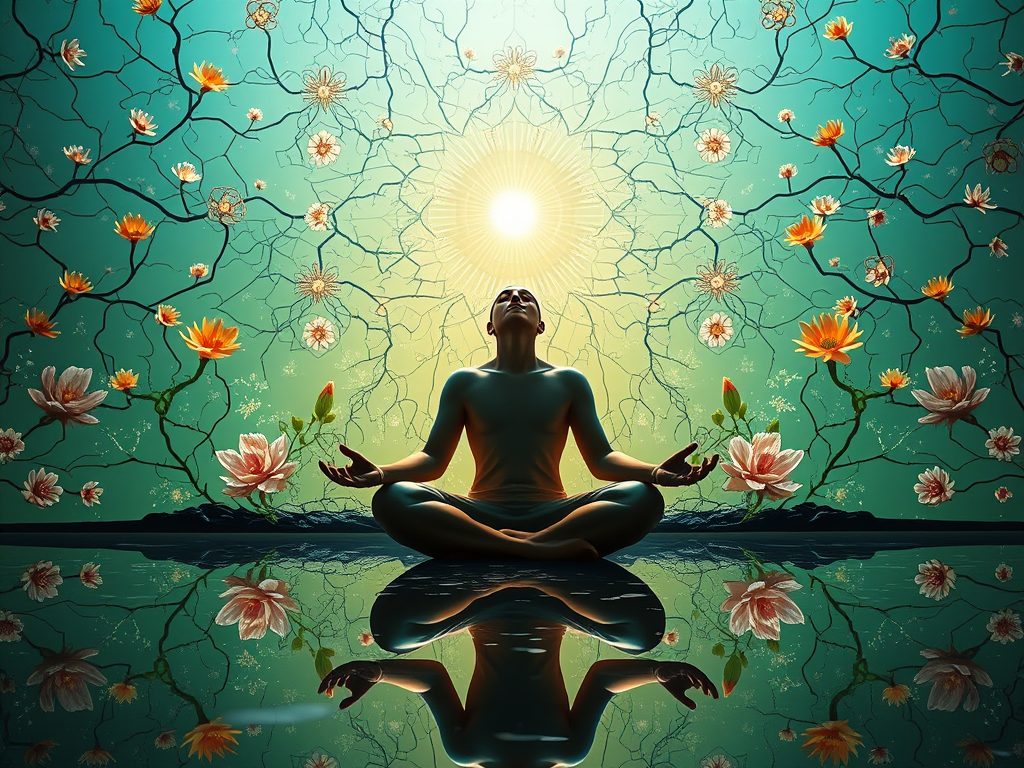
Enlightenment has a reputation for being a religious or spiritual concept, and I have deep respect for monks and spiritualists who seek and find enlightenment. However in this article I’d like to outline a more scientific approach to understanding enlightenment.
First of all, what is enlightenment? My understanding is that it’s an extremely deep release of joy. The idea is that there are what might be thought of as dams preventing our joy from being fully expressed and enlightenment is breaking a dam. It’s possible that different people have different amounts of dams. Some people might need to break through multiple to find the inner peace they’re looking for.
Now I’d like to examine the process of finding enlightenment, or breaking dams, through a few different lenses.
First let’s think about it from a psychological perspective. We all have a complex interplay of thoughts, emotions, behavioural patterns, intuitions, and more. The idea here is that a limiting belief, unresolved emotional baggage, a destructive behavioural pattern, or an incorrect intuition – all of these things could be preventing us from fully expressing our joy. If someone manages to identify a limiting belief that is deep enough, maybe something they learned in childhood, and realize it’s incorrect, maybe that would be enough to break a dam preventing us from fully expressing our joy, and allowing us to have an enlightened moment. Similarly if they could fully resolve their emotional baggage, correct a destructive behavioural pattern, or identify and correct an incorrect intuition. Psychologists would surely have more examples of things that prevent us from fully being happy.
Next let’s think about it from a biological perspective. As living beings we have extremely complex nervous systems. I’m not an expert in physiology, but I would bet that most if not all of what we experience is the firing of this nerve or that nerve. Our stress response, our reward system, and our thoughts – they all involve nerves in the brain or in the body. I think we don’t fully use our nervous systems! If someone is able to reconnect a deep nerve that is used for a positive emotional response, this could be enlightenment.
Finally let’s think about it from a self-improvement point of view. There are certain skills that I think when developed to a great enough extent can result in enlightenment. I’m talking about things like awareness (mindfulness is a very popular skill these days) and contemplation. If someone were to train these skills rigorously and become extremely aware, through say practicing meditation, or become extremely insightful to themselves through the practice of thinking (though I think reading and writing deserve a mention here too), I think they could land on some astounding observation or thought that would delight them so much it would result in enlightenment.
I think enlightenment was popularized by religion and most of us, if we care about the topic, feel we need to follow Buddhist moral behaviour or follow the path of the yogi to find it, but I hope in this article I’ve been able to demonstrate that the concept of enlightenment can be separated from religious thought and thought of instead in completely practical or scientific terms.
If you are seeking enlightenment, I hope you don’t get too discouraged that it’s practically impossible without becoming a monk to follow the old ways of thought, and that you enjoy your practices of self discovery in the modern world!




 Stream2
Leave a comment